Eight of Swords Tarot Card Meaning
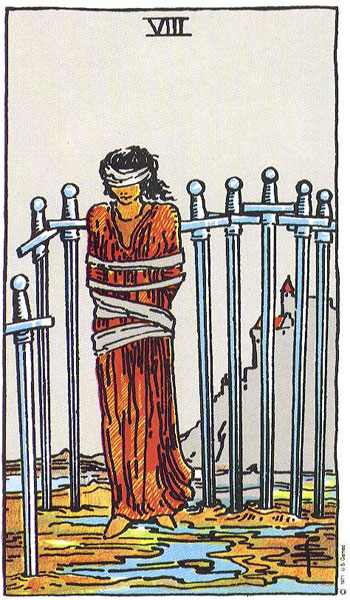
The Eight of Swords is the feeling of being unable to move — bound, blindfolded, swords like a fence. Some cages are real. Some are thoughts that have been rehearsed until they feel like iron. The card asks you to test which is which, without shaming either.
- Arcana: Minor
- Suit: swords
- Element: Air
- Traditional keywords: restriction · feeling trapped · limiting beliefs · helplessness · isolation
- Mystic Draw themes (upright): feeling fenced in · a story that binds · limited options · waiting to be allowed
- Mystic Draw themes (reversed): the cloth loosening · a first step · seeing the gaps · help entering the frame
Upright meaning
Upright, this card takes stuckness seriously. You may be in a job, a story, a family pattern, or a mental loop that has narrowed the available paths. The figure is not foolish for standing still; the swords are sharp, and the ground is wet. At the same time, Smith’s image leaves gaps in the circle of blades, and a castle on the hill — structures of help or of the old life, still visible. The suit of Air suggests that belief is part of the rope. That is not the same as saying “it’s all in your head.” Thoughts have consequences. So do landlords, diagnoses, and other people’s rules. The work is to name the actual constraints, then to look again for the gap you stopped checking.
Reversed meaning
Reversed, a knot may be slipping. You try a small movement. You ask for help. You notice that one sword was never locked. The reversal can also show the dizzy first days of freedom, when the blindfold is off and the light hurts. Or it can show a person who has been told they are free while the ropes are still on — optimism as another kind of cloth. Go slowly. Liberation that ignores the body becomes a new performance. If you are supporting someone else, do not yank the blindfold. Offer a hand and time.
Love and relationships
In love, the Eight of Swords can be the relationship you stay in because the alternatives feel impossible — money, children, fear, a vow you made when you were a different person. It can also be the inner sentence “I am too much / not enough to leave or to stay.” None of this is a command to end or to endure. It is a request to look at the ropes with a witness who does not benefit from your remaining still. Safety planning, if you need it, is more important than a poetic reading. Cards do not replace that.
Career and work
At work, this is the role that has become a pen, the skill you are not “allowed” to use, the meeting culture that treats questions as disloyalty. Impostor stories can bind as tightly as a contract clause. Write down what is actually forbidden versus what you have inferred. A mentor, a union, a quiet application, a boundary around after-hours thought — these are gaps in the fence. You do not have to charge. You might only need to turn your head.
Money and practical life
As a money reflection, the Eight of Swords often sits with scarcity stories: I cannot look, I cannot ask, I cannot change this. Some limits are mathematical. Some are shame wearing arithmetic’s coat. Opening a statement, calling a person whose job is to explain options, or admitting you do not understand a form can be a first untying. This is not a prediction of rescue or of ruin. It is permission to treat confusion as a solvable fog rather than as a personality.
Personal growth
For growth, this card is practice in testing a belief with a small, safe experiment. If the thought is “I cannot,” ask “cannot yet, cannot alone, or cannot this way?” The answers are different medicines. Somatic work — feeling the feet, the breath, the places the rope lives in the shoulders — helps Air become information instead of a sentence. You are allowed to be both constrained and still in possession of a next inch of movement.
Imagery and symbolism
In the Rider–Waite–Smith Eight of Swords, a standing figure in a red garment is loosely bound and blindfolded, surrounded by eight swords stuck in wet, uneven ground. Behind, a castle or village sits on a rise. The bindings do not look professionally tight; the circle of swords is incomplete. Smith’s puddles and grey sky make the scene miserable rather than theatrical. Waite spoke of restriction and a crisis of a kind — yet the composition quietly argues that the prison is not a dungeon with a locked door. It is a field. That is not the same as easy. It is a different kind of hope.
What this card may be asking you to notice
Notice which of your “I can’t” sentences you have not tested in a year. Notice who benefits if you stay still. The Eight of Swords often asks for one small, reversible experiment rather than a dramatic escape scene.
Related cards
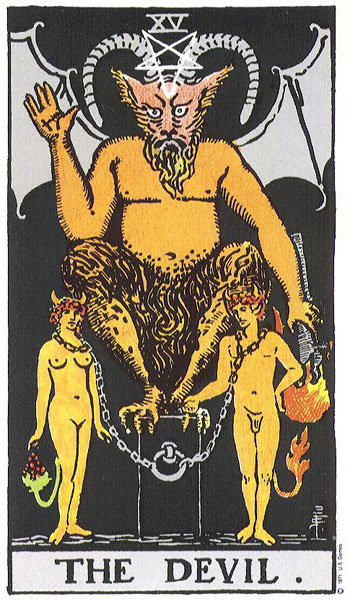 The DevilThe Devil names bondage you have, in some way, agreed to—addiction, status games, shame, golden handcuffs. Upr…
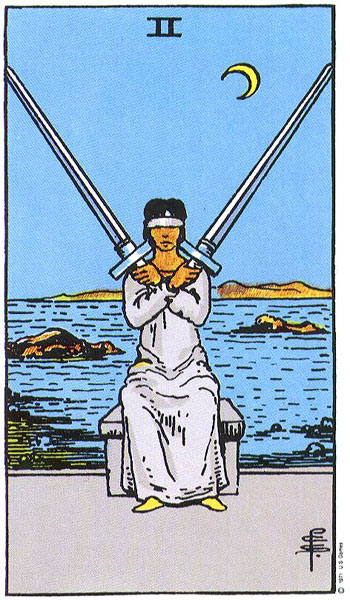 Two of SwordsThe Two of Swords is the moment you cross your arms around a decision and call it peace. Sometimes that pause …
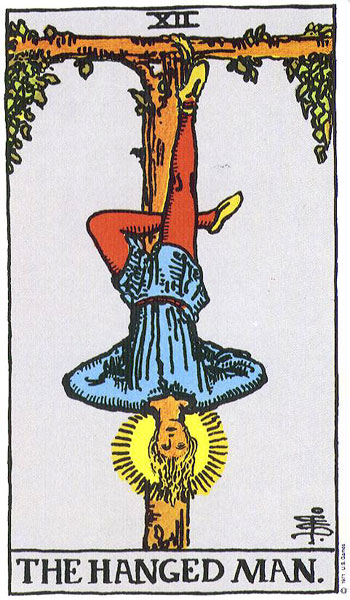 The Hanged ManThe Hanged Man suspends ordinary motion so a new angle appears. Surrender is active: you stop forcing until me…
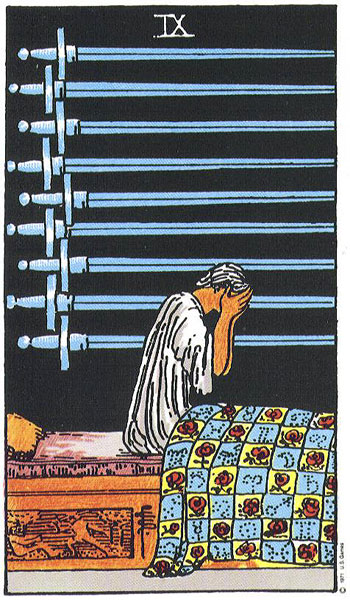 Nine of SwordsThe Nine of Swords is the hour when thought becomes a room you cannot leave. Worry, shame, or grief rehearses …
Questions people ask
What does the Eight of Swords tarot card mean?
It often reflects feeling trapped — by circumstances, by a story, or by both. Mystic Draw holds the card without gaslighting: some cages are real. The image also leaves gaps. The invitation is to name the actual ropes and to look again for a next, small movement.
Is the Eight of Swords “all in your head”?
No. Thoughts can tighten a situation, and situations can generate those thoughts. Reducing the card to a pep talk would be unkind. Use it to sort facts from inferences, and to seek practical help where the constraints are material or unsafe.
What might reversed Eight of Swords mean?
A loosening: insight, help, a first step, or the disorientation of not being bound the old way. It can also warn against calling yourself free while the ropes remain. Pace matters. Freedom that ignores the nervous system rarely lasts.
This page is a reference. Mystic Draw draws cards at random in a reading — it cannot promise this card will appear. How a three-card reading works · How to read tarot cards.