The Fool Tarot Card Meaning
The Fool marks a threshold. You are invited to begin before every detail is known—not as a dare to be reckless, but as permission to stay honest with a desire to grow. Curiosity, good faith, and a little naivety can be medicine when planning has already said everything it can say.
- Arcana: Major
- Element: Air
- Traditional keywords: beginnings · innocence · spontaneity · free spirit · leap of faith
- Mystic Draw themes (upright): threshold · curiosity · good faith · beginner’s mind · unmapped travel
- Mystic Draw themes (reversed): blind spots · false caution · novelty as escape · unread terms · edge-freeze
Upright meaning
The Fool, numbered zero, sits outside the numbered procession of the Majors and still belongs to it. Upright, the card rewards the part of you that can take a first step without a complete itinerary. Travel, study, a new chapter, or a conversation you have postponed often sit close to this image—not because the card promises a particular outcome, but because thresholds teach what rehearsal never will.
What looks like innocence here is not ignorance of consequence. It is a refusal to let fear of looking unprepared become the whole personality. The Fool’s gift is motion with open eyes: pack what you actually need, notice the dog at your heels, and still let the path be a path rather than a fortress of hypotheticals.
Reversed meaning
Reversed, the same leap can turn into blind spots: signing on without reading the terms, chasing novelty to outrun grief, or treating other people’s lives as scenery for your adventure. The cliff is still there; the difference is whether anyone is watching the edge.
The reversal can also freeze you at the brink. Fear dresses itself as “being sensible” when the real ask is gentler preparation—one grounded check-in, one honest budget, one person who will tell you if you are about to step into fog. The Fool reversed is not a verdict that you should never begin. It is a request to distinguish courage from numbness.
Love and relationships
In love, the Fool often names a fresh start, a willingness to be seen before you have a polished story, or a turn toward play after a season of cynicism. Attraction can feel light here: less a contract, more a walk. That lightness is useful when it restores honesty. It is less useful when charm is mistaken for compatibility, or when “we’ll figure it out” becomes a way to avoid naming what you actually need.
If you are already partnered, the card may ask whether the relationship still has room for surprise—or whether you have both become so careful that nothing living can enter. Check that the leap you are taking is toward someone, not away from yourself.
Career and work
At work, the Fool favors pilots, apprenticeships, pivots, and learning curves. A new role or a first public attempt at a craft can sit here. The card does not grade you on looking senior. It notices whether you can stay curious when the room expects certainty.
Pace the risk. One grounded check-in—a mentor, a runway of savings, a written hypothesis for the experiment—keeps the Fool from becoming a stunt. If you have been circling the same job because leaving would make you look naive, the card may be asking what “looking naive” is protecting.
Money and practical life
Money around the Fool is often about first outlays: a course, a move, a period of lower income while a skill forms. The image of the small pack is practical. You do not need to carry the whole old life into the new one, and you also do not need to throw away every tool.
Treat this as a conversation about what you can actually afford to learn, not a prediction of windfalls. If spending has become a way to feel like a person who is “in motion,” the reversal’s warning about unread terms applies as much to subscriptions and impulsive gear as to contracts.
Personal growth
Spiritually, the Fool is beginner’s mind. Omens, synchronicity, and sudden yeses can feel loud beside this card, and they are worth noticing—so is a map for your body and your budget. Growth here is the humility of being new without making a religion of chaos.
The zero is a circle as well as an absence. Each time you complete a World-cycle, some version of the Fool returns. The work is to begin again without pretending you never learned anything, and without using experience as a reason never to be unguarded.
Imagery and symbolism
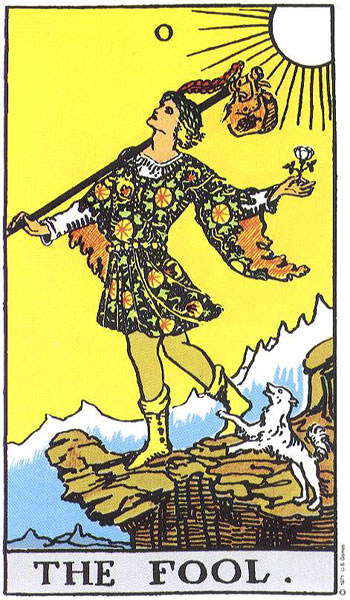
In the Rider–Waite–Smith deck of 1909, Pamela Colman Smith places a young traveler at a cliff’s edge, face lifted toward a pale sun rather than down at the drop. A.E. Waite numbered the card 0, keeping the Fool as both outsider and origin. The white rose in the left hand is often read as spirit or innocence that has not yet been bargained away; the knapsack on a staff holds what the old life still insists on packing.
The little white dog may warn or cheer—Waite called it an attendant of the mind, not a simple mascot. Mountains wait in the distance, which matters: the journey is pictured as real terrain, even when the path immediately ahead looks empty. Smith’s motley and yellow boots keep the figure theatrical; this is a beginning that knows it is being watched, including by you.
What this card may be asking you to notice
Notice where you are calling something a leap when it is actually an unread agreement—and where you are calling something caution when it is only the wish not to be seen starting. The dog at the heel is useful: what small, living signal are you ignoring because the horizon looks more romantic?
Related cards
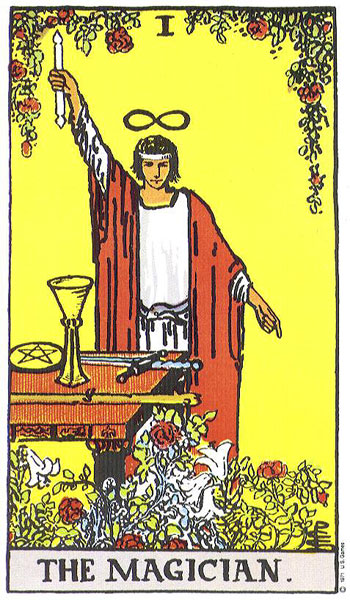 The MagicianThe Magician names concentration. The tools are already on the table—wand, cup, sword, coin—and a channel is p…
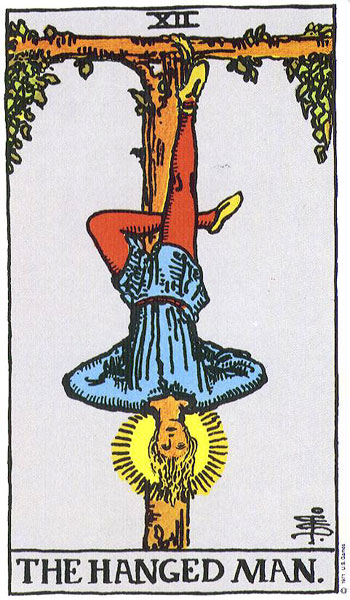 The Hanged ManThe Hanged Man suspends ordinary motion so a new angle appears. Surrender is active: you stop forcing until me…
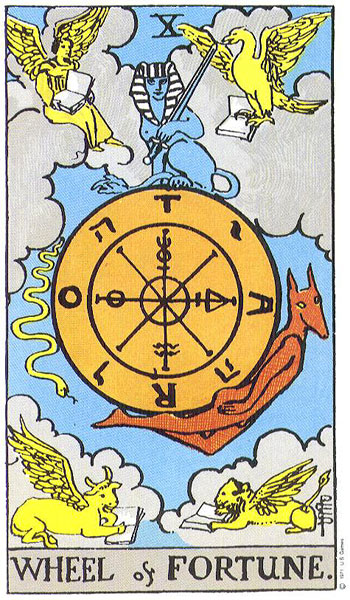 Wheel of FortuneThe Wheel reminds you that seasons turn: luck, timing, the feeling that a chapter is changing its weather. Upr…
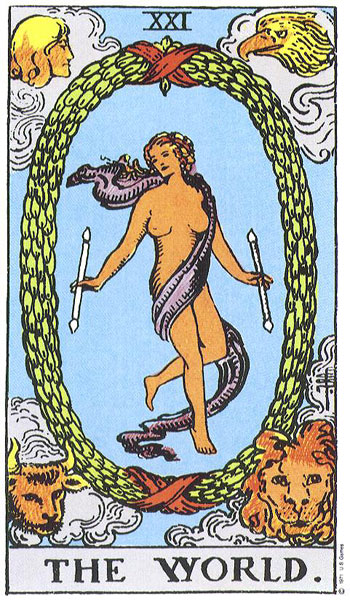 The WorldThe World closes a major cycle with integration: travel, graduation, wholeness that includes shadow. You know …
Questions people ask
What does the Fool tarot card mean?
It usually names a threshold: a beginning that cannot be fully planned in advance. In Mystic Draw we read it as an invitation to curiosity and good faith, not as a promise that a leap will be rewarded. The surrounding cards and your question decide whether the edge is a genuine opening or a place to pause and pack more carefully.
What can the Fool suggest in love?
It can point to vulnerability, play, or a chapter that has not yet grown a shared language. That may feel like a new connection or like choosing lightness inside an existing one. It does not tell you that a particular person is “the one”; it asks whether you are confusing charm, novelty, or the relief of being chosen with a fit you could actually live inside.
How might the Fool reversed be read?
Reversed, the same image can highlight recklessness, ignored consequences, or the opposite freeze: staying at the cliff because fear has borrowed the voice of wisdom. Neither reading is a command to jump or to stay. It is a prompt to name what you have not looked at—grief, terms, timing—and to take the next honest step, which might be preparation rather than motion.
Is the Fool only about travel or being young?
Travel and youth appear often in the picture, but the card is about the posture of beginning. You can draw the Fool at any age when a role, belief, or identity is ending and the next shape is not yet solid. The white rose and the pack matter as much as the cliff: what are you carrying, and what are you still willing to keep simple?
This page is a reference. Mystic Draw draws cards at random in a reading — it cannot promise this card will appear. How a three-card reading works · How to read tarot cards.