Seven of Pentacles Tarot Card Meaning
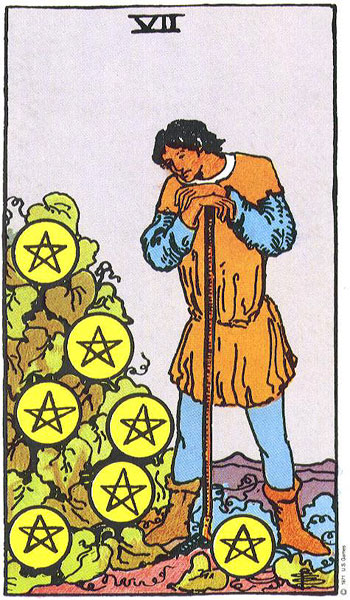
The Seven of Pentacles is the farmer’s interval — not sowing, not yet selling. You lean on the tool and look at what the work has become. Some clusters are coming. Some are not. The wisdom is in the looking, not in panic-harvesting green fruit.
- Arcana: Minor
- Suit: pentacles
- Element: Earth
- Traditional keywords: assessment · patience · long-term view · investment · review
- Mystic Draw themes (upright): the long look at the vine · patience with results · assessment · labor that is not yet ripe
- Mystic Draw themes (reversed): impatience with the soil · effort without fruit · abandoning the row too soon · harvest anxiety
Upright meaning
Upright, this card blesses a review that is neither smug nor despairing. You have put time into something: a skill, a relationship’s daily maintenance, a body of work, a slow financial habit. Now you are allowed to ask what it is doing. Earth is slow on purpose. That does not mean you must tend a dead vine forever. It means you look with a gardener’s eye: more water, different crop, a season of rest, a celebration of what is actually hanging there. The figure in Smith’s card is tired and still present. Presence is the magic. Hustle culture hates this card because it will not perform a montage. Growth that lasts rarely looks like a montage.
Reversed meaning
Reversed, the wait curdles. You refresh the soil every hour, or you walk away from a row that needed one more season, or you decide the lack of instant fruit means you are the problem. Burnout wears this face: labor without a theory of harvest. So does comparison — everyone else’s vine looking more photogenic from the road. The reversal asks for an honest agronomy: was the original planting even what you wanted, or a crop you took on for someone else’s table? You can change fields without calling yourself a quitter. You can also stay and stop digging the roots up to check them. Both can be adult.
Love and relationships
In love, the Seven of Pentacles is the long middle — after the Ace’s spark, before anyone’s anniversary speech. Are you growing something, or performing effort? Couples who never pause to look will wake up in a field they did not mean to plant. A kind review is not a threat. It is “what is thriving, what needs a different kind of care, what was never our crop?” If you are waiting for someone to become a harvest they have not agreed to be, the vine is telling you. Patience is for living processes. It is not a strategy for postponing a truth.
Career and work
At work, this is the project in month seven, the craft before it is famous, the job that is quietly compounding skill. Assessment belongs here: portfolio, metrics you actually respect, a conversation with someone who knows the crop. If the culture only loves launches, you may need to protect the looking. If nothing is fruiting and the soil is bad, staying is not loyalty; it is a sunk-cost altar. Good farmers change tactics. They do not worship the hoe.
Money and practical life
As a money reflection, the Seven of Pentacles is the unglamorous look at whether a pattern is working — a habit, a plan, a hope that time would do the rest. It does not tell you to invest, divest, or wait for a windfall. It asks you to observe what your attention and labor have actually grown, with as little drama as a person leaning on a hoe. Some fruits take seasons. Some vines were ornamental. Knowing which is which is a form of peace that no hot tip can sell you.
Personal growth
For growth, this card is the spiritual skill of delayed evidence. You will not always feel the harvest while you are in the row. The practice is to choose signs of life that are real (a slightly stronger boundary, a draft that exists, a body that sleeps) rather than signs that photograph well. Rest the tool. Look. Then decide. Looking is not laziness. It is how Earth stays intelligent.
Imagery and symbolism
The Rider–Waite–Smith Seven of Pentacles shows a young farmer resting both hands on a hoe, gazing at a vine where six pentacles grow like fruit; a seventh sits on the ground near the tool. The tunic is simple; the sky is the color of late afternoon. Waite described a pause in the labor of the money-suit, a consideration of whether the work will pay. Smith’s vine is heavy and a little wild — not a spreadsheet. The figure’s back is slightly bent. This is not the Eight’s absorbed hammering, and not the Nine’s leisure in a finished garden. It is the middle, which is where most of a life is spent.
What this card may be asking you to notice
Notice whether you only count fruit that strangers would applaud. Notice the row you tend from guilt rather than from choice. The Seven of Pentacles often asks you to rest the hoe long enough to see the actual vine.
Related cards
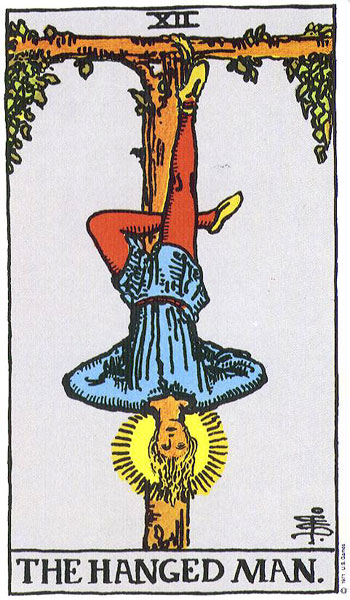 The Hanged ManThe Hanged Man suspends ordinary motion so a new angle appears. Surrender is active: you stop forcing until me…
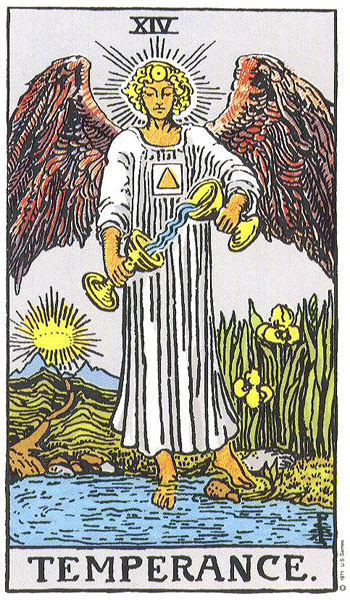 TemperanceTemperance mixes opposites into something drinkable: patience, alchemy, moderation with purpose. Healing integ…
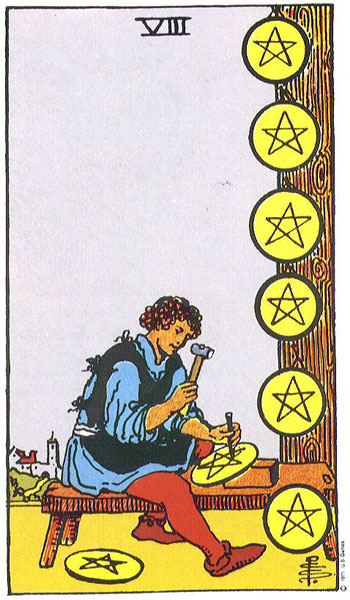 Eight of PentaclesThe Eight of Pentacles is apprenticeship you can hear: hammer, coin, hammer, coin. Mastery is not a mood. It i…
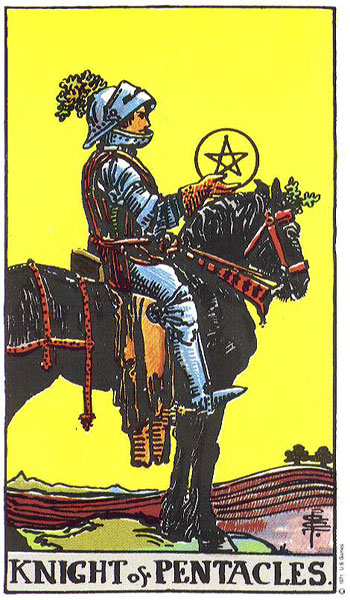 Knight of PentaclesThe Knight of Pentacles is the suit’s promise kept — same field, same coin, a horse that has not been asked to…
Questions people ask
What does the Seven of Pentacles tarot card mean?
It often means a pause to assess long labor — looking at what has grown before the final harvest. Mystic Draw reads it as intelligent waiting, not as stuckness. The vine may need more time, different care, or an honest change of crop.
How does Seven of Pentacles speak to love?
As the long middle of a bond: daily tending, a review of what is alive, patience that is not a delay tactic. It asks whether you are growing a shared field or waiting for a harvest the other person never planted.
What might reversed Seven of Pentacles mean?
Impatience, fruitless effort, walking away too soon, or staying as a sunk-cost ritual. The work is honest agronomy: what is this vine actually doing, and is it even your field?
This page is a reference. Mystic Draw draws cards at random in a reading — it cannot promise this card will appear. How a three-card reading works · How to read tarot cards.