Seven of Swords Tarot Card Meaning
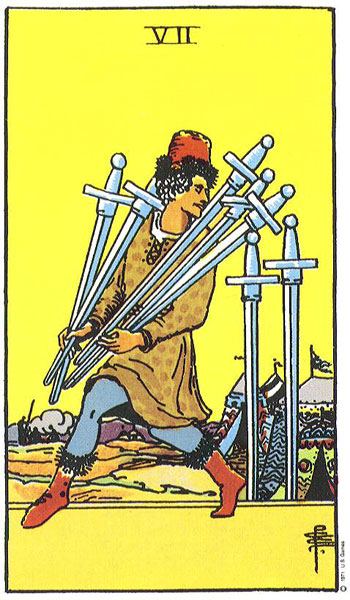
The Seven of Swords is the card of the unofficial exit — five blades in the arms, two left standing, a look back at the tents. It can be cunning, self-protection, or a habit of not being fully seen. The question is what you are taking, and from whom, including yourself.
- Arcana: Minor
- Suit: swords
- Element: Air
- Traditional keywords: strategy · deception · stealth · avoidance · cunning
- Mystic Draw themes (upright): strategy · slipping out of camp · a private plan · what is being carried off
- Mystic Draw themes (reversed): coming clean · the ruse thinning · returning a blade · strategy that no longer fits
Upright meaning
Upright, this card asks you to look at strategy that happens off the main path. Sometimes that is healthy: leaving a situation without a speech, gathering your ideas before a committee waters them down, protecting a plan until it can stand. Sometimes it is a leak in trust — yours or someone else’s. The figure is not a cartoon villain. He is busy, slightly ridiculous, and very human. The two swords remaining in the ground are the part of the truth that will not travel in secret. You can only carry so much without dropping a blade. That limit is the card’s quiet ethics.
Reversed meaning
Reversed, the camp may be waking. A story unravels. You confess, or you are found, or you simply get tired of the double bookkeeping of a half-life. The reversal can also be a strategy that was never as clever as it felt — overthinking dressed as stealth. Coming clean is not always public. Sometimes it is returning the energy you spent hiding and using it to live one story instead of two. If you have been the one deceived, reversed does not demand instant forgiveness. It asks what you now know, and what you no longer have to pretend not to know.
Love and relationships
In love, the Seven of Swords can be omission as much as affair: the message left unread, the feeling not mentioned, the second life on a phone. It can also be a person quietly reclaiming themselves from a relationship that monitors too much — packing their thoughts and leaving without a scene. Mystic Draw will not use this card to accuse. We will ask whether secrecy is protecting harm, or protecting a self that has not been safe to show. Those are different moral weather systems. Only you, with your facts, can tell them apart.
Career and work
At work, this is the side project, the quiet job search, the idea you develop before the room can kill it — or the credit that walks out of the meeting in someone else’s notebook. Politics and prudence share a silhouette here. Document what is yours. Be honest about whether you are being strategic or simply unavailable for accountability. A clean process is not naive. It is a way to keep your future self from having to explain a mess in the tents.
Money and practical life
As a money reflection, the Seven of Swords invites you to look at what is off-ledger: subscriptions you hide, a debt you have not mentioned, a hope that a problem will remain uncounted. It is not a prediction of theft or a command to confess to a bank. It is a mirror for split attention. Money stories that require a second set of books tend to cost more in sleep than they save in pride. Bringing one number into the light can be enough for today.
Personal growth
For growth, this card is about the energy leaked by living at an angle. Not every private thought must be published. Privacy is not the same as deceit. The practice is to know which you are doing. If you are always the one slipping out of camp, ask what the camp did not make room for. If you are always scanning for who might be slipping, ask what it costs to live on patrol. Integrity is a lighter load than five stolen swords.
Imagery and symbolism
The Rider–Waite–Smith Seven of Swords shows a figure in motley tiptoeing away from a military encampment, five swords gathered awkwardly in his arms, two left standing in the ground. He looks back over his shoulder. Tents and people occupy the middle distance. The sky is yellow-grey, a color of neither night nor honest noon. Smith’s composition is almost comic — the theft is not elegant. Waite associated the card with unstable effort and partial success. The leftover swords are the punchline: you cannot take the whole truth with you when you leave like this.
What this card may be asking you to notice
Notice which of your plans could survive daylight. Notice what you are leaving planted in the ground on purpose. The Seven of Swords often asks whether stealth is still serving the person you want to be when the tents wake.
Related cards
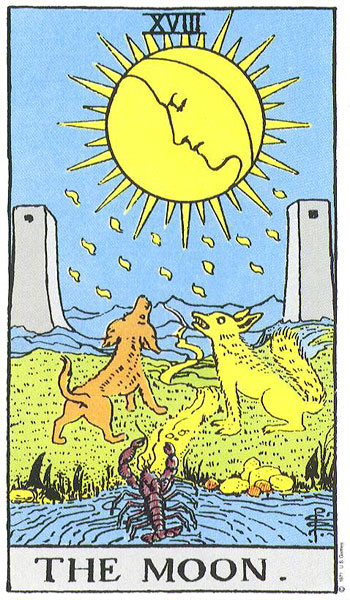 The MoonThe Moon walks the liminal: dreams, projections, what you sense but cannot yet prove. Anxiety and intuition sh…
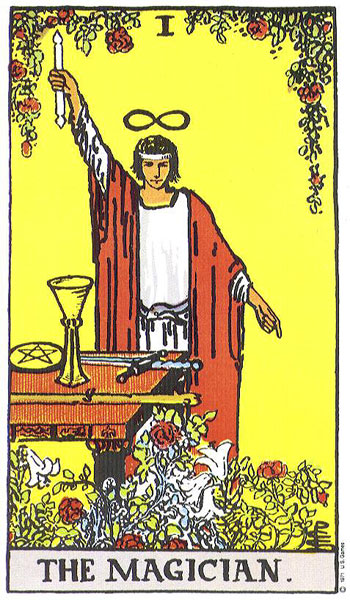 The MagicianThe Magician names concentration. The tools are already on the table—wand, cup, sword, coin—and a channel is p…
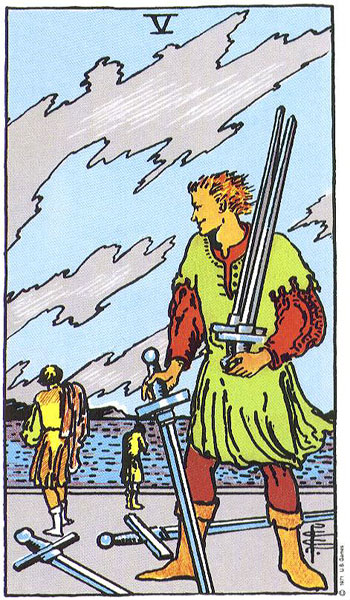 Five of SwordsThe Five of Swords is the quiet after a quarrel that someone “won.” Swords lie on the ground. People walk away…
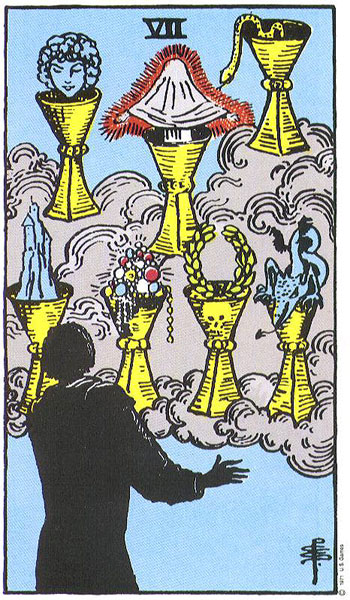 Seven of CupsA silhouette stares at seven cups in the clouds, each holding a different prize or monster. The Seven of Cups …
Questions people ask
What does the Seven of Swords tarot card mean?
It often reflects strategy, secrecy, or a partial exit — taking what you can carry and leaving something behind. Mystic Draw does not rush to the word “liar.” Context matters: self-protection and deceit can look similar in silhouette. The leftover swords are the ethical clue.
Does Seven of Swords mean someone is cheating?
It can appear around omission and double lives, including infidelity, but it is not a courtroom exhibit. It can equally describe a quiet reclaiming of self. Use it as a prompt to look at secrecy in your actual situation, not as a verdict from the sky.
What might reversed Seven of Swords mean?
A ruse thinning, a confession, a return to one story, or a clever plan that was never that clever. If you were misled, the reversal may simply mark the moment you stop participating in the performance. You get to choose what you do with the knowledge.
This page is a reference. Mystic Draw draws cards at random in a reading — it cannot promise this card will appear. How a three-card reading works · How to read tarot cards.