Five of Swords Tarot Card Meaning
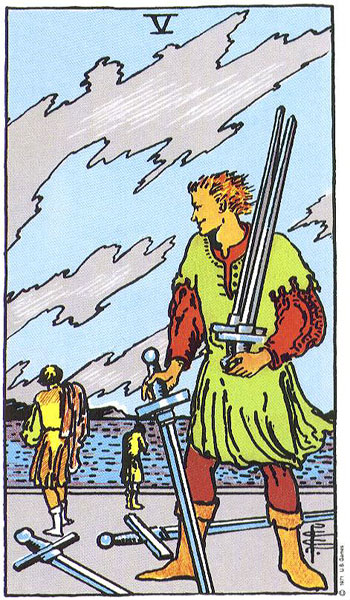
The Five of Swords is the quiet after a quarrel that someone “won.” Swords lie on the ground. People walk away. The sky is still sour. The card asks what the victory cost, and whether you still want to carry every blade you picked up.
- Arcana: Minor
- Suit: swords
- Element: Air
- Traditional keywords: conflict · defeat · hollow victory · tension · self-interest
- Mystic Draw themes (upright): a costly win · conflict’s aftermath · picking up blades · hollow victory
- Mystic Draw themes (reversed): laying a sword down · choosing not to fight · repair after a scene · the argument’s hangover
Upright meaning
Upright, this card looks at conflict without romance. Someone collected the swords; someone else left them. There can be humiliation, gloating, or the numb efficiency of a person who has learned that being right is safer than being close. Not every disagreement is abuse, and not every win is cruelty — but this image is specifically about leftover harm. The wind is against the figures. Even the “winner” stands in a landscape that has not forgiven the scene. The honest question is not who scored the point. It is whether the relationship, the team, or your own self-respect can afford this style of being correct.
Reversed meaning
Reversed, there may be a chance to put a sword down. An apology that is actually an apology. A decision not to send the message. A recognition that you were fighting to avoid feeling small. The reversal can also show conflict you are tired of but still circling, or shame after a scene you wish you could unsay. Repair is not the same as pretending nothing happened. It is slower, and it usually requires one person to stop collecting blades. If you were on the receiving end, reversed does not demand that you reconcile. It asks what safety would look like now.
Love and relationships
In love, the Five of Swords can be the fight that uses intelligence as a weapon: scorekeeping, the perfect cutting sentence, winning the chronology. It can also be the aftermath — two people in the same home, not looking at each other. Mystic Draw will not tell you who is the villain. We will ask whether the goal is still connection. If it is, the next move is rarely another proof. If it is not, leaving the swords on the ground may be the kindest form of honesty. Either way, contempt is expensive.
Career and work
At work, this is office politics with a paper trail, a meeting that humiliated someone, a negotiation where “winning” poisoned the follow-through. Brilliant people can still create rooms no one wants to enter. If you are the one holding extra swords, notice whether competence has become a way to stay un-hurtable. If you were diminished, documenting facts is different from plotting a sequel. The card favors choosing battles that protect dignity — yours and other people’s — rather than battles that only protect rank.
Money and practical life
As a money reflection, the Five of Swords can describe deals, arguments about who owes what, or a habit of treating every exchange as a contest. Being “right” about a bill can still cost a relationship that was worth more than the bill. This is not a prediction of financial harm. It is a question about the tone of your negotiations, including the ones you have with yourself. Fairness and domination are easy to confuse when you are scared.
Personal growth
For growth, this card is an education in the difference between a boundary and a trophy. You can tell the truth without collecting an audience. You can walk away without a speech. If you tend to abandon yourself to keep peace, the Five of Swords is not asking you to become cruel; it is asking you to stop confusing self-erasure with virtue. If you tend to win at a cost, practice leaving one sword on the sand.
Imagery and symbolism
In the Rider–Waite–Smith Five of Swords, a smirking figure gathers three swords in the foreground while two more lie on the ground. Two other people walk toward a choppy sea under a torn, yellowish sky. The “victor” looks back, not forward. Waite described a scene of loss and dishonor as much as of triumph. Smith’s wind-blown hair and sour clouds matter: nobody looks rested. This is not the honorable combat of other decks’ knights. It is the human mess after words have already done their work.
What this card may be asking you to notice
Notice the expression you make when you are winning an argument. Notice who has already left the frame. The Five of Swords often asks whether you want the last word, or a world you still want to live in tomorrow.
Related cards
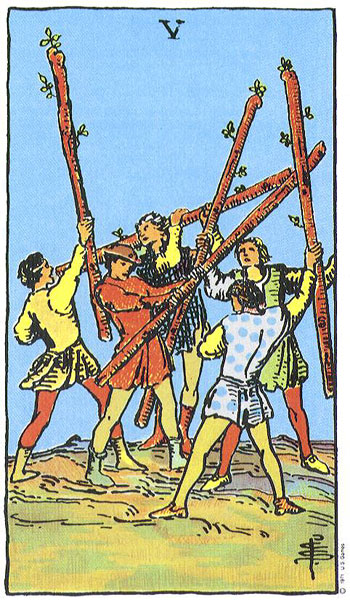 Five of WandsFive youths swing staves that cross but do not quite wound. The Five of Wands is friction with a pulse: compet…
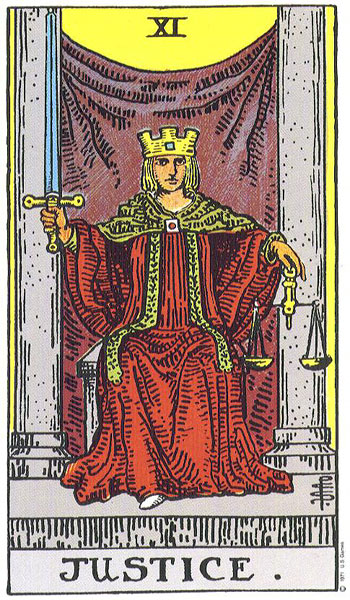 JusticeJustice weighs truth: contracts, ethics, cause and effect. Upright, clarity arrives—sometimes legally, sometim…
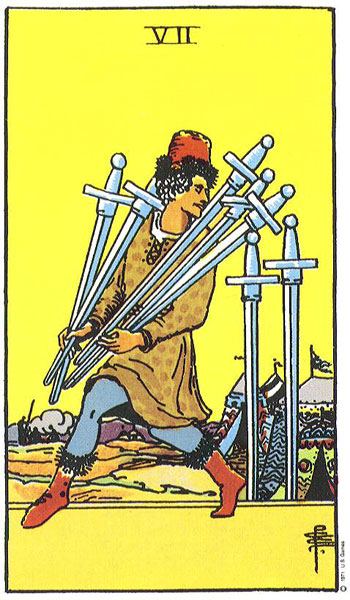 Seven of SwordsThe Seven of Swords is the card of the unofficial exit — five blades in the arms, two left standing, a look ba…
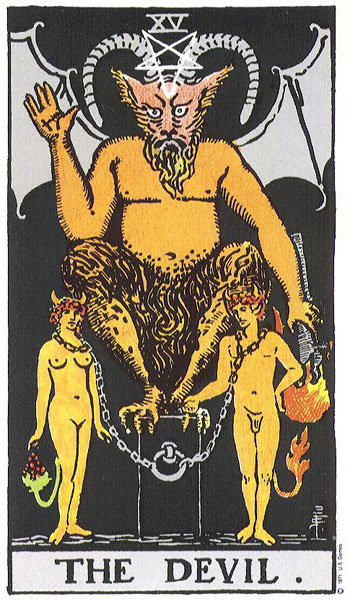 The DevilThe Devil names bondage you have, in some way, agreed to—addiction, status games, shame, golden handcuffs. Upr…
Questions people ask
What does the Five of Swords tarot card mean?
It often reflects conflict that leaves a residue — a win that cost too much, a quarrel that humiliated someone, or the lonely job of picking up blades after the others have walked away. Mystic Draw reads it as a question about cost, not as a cheer for combat.
How does the Five of Swords speak to love?
It can describe fights that prize being right over being kind, or the cold weather after such a fight. It does not assign a villain. It asks whether the relationship can survive this style of winning, and what repair would require if anyone still wants one.
What could reversed Five of Swords be showing?
A chance to stop, apologize, or refuse the next round. It can also show shame, lingering hostility, or conflict you are done with but have not yet put down. Safety comes first. Reconciliation is optional and should never be demanded by a card.
This page is a reference. Mystic Draw draws cards at random in a reading — it cannot promise this card will appear. How a three-card reading works · How to read tarot cards.