The Hermit Tarot Card Meaning
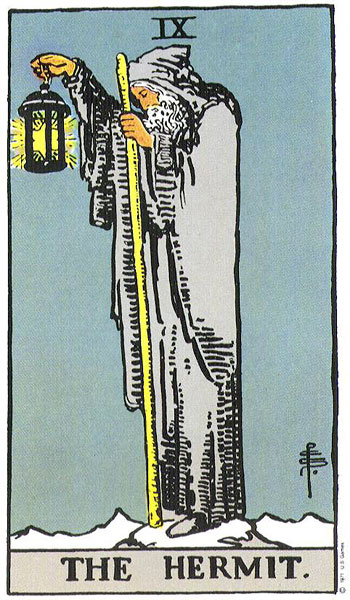
The Hermit turns inward on purpose: retreat to hear a voice that crowds drown out. Guidance sought here is earned through solitude, study, or careful conversation with a wise other—not isolation as punishment, but as laboratory. The lantern lifts only the next step; the whole mountain does not have to be floodlit at once.
- Arcana: Major
- Element: Earth
- Traditional keywords: solitude · introspection · guidance · withdrawal · inner light
- Mystic Draw themes (upright): chosen solitude · inner guidance · study · the next step only · earned perspective
- Mystic Draw themes (reversed): exile · hiding · terminal busyness · cynicism · loneliness as identity
Upright meaning
Upright, the Hermit is a deliberate dimming of the social field. You may need a walk, a library, a week without performing, a therapist’s room that is not a party. The point is not to become impressive in your withdrawal. The point is to hear what cannot be heard at full volume.
Nine is a number of near-completion in many tarot conversations. The Hermit often arrives when you have enough experience to interpret your own life, if you will stop outsourcing every interpretation. The lantern is small on purpose. Wisdom that insists on illuminating the entire future is usually selling something.
Reversed meaning
Reversed, loneliness becomes exile, cynicism, or hiding. You may also be avoiding necessary alone time by staying terminally “on”—messages, noise, a calendar that never lets the snow settle.
The reversal can be a person who has made a personality out of not needing anyone, or a person who cannot bear a single evening with their own mind. Both are lantern problems. One refuses to come down the mountain. The other refuses to climb far enough to see.
Love and relationships
In love, the Hermit asks for space to know your needs, and for depth over constant contact. A bond can be real and still require nights that belong to one person. If you treat every silence as abandonment, you may be asking a partner to replace your own inner guide.
If you are single, the card is not a curse of solitude. It may be a season of becoming someone who can be accompanied without disappearing. If you are paired, it may be a request for a wiser kind of distance: not a wall, a study.
Career and work
Work here is research, mentorship, senior craft, the refusal of the hype cycle. You may be the person who should not be in every meeting. You may need to step back from a public-facing role long enough to remember what you actually know.
The Hermit is a poor mascot for burnout-as-identity, the colleague who is always “heads down” and never available. Chosen solitude produces a lantern. Resentful isolation produces a locked door. Know which one you are carrying.
Money and practical life
Money with the Hermit is often simpler: fewer performances of success, more honest accounts. A period of lower social spending, a sabbatical, a refusal to buy belonging, can all sit here.
It is not a prediction that you will become rich by withdrawing from the world. It is a prompt to see your resources without an audience. If loneliness is driving purchases—gear for a self you have not become, courses that postpone the work—the lantern is pointing at the next small, unglamorous step, not at another acquisition.
Personal growth
Spiritually, night walks, journals, slow practices. Answers arrive in lower volume. The Hermit is not anti-community; the lantern is eventually for others too, which is why this figure is also the old man who returns with a light.
Growth is distinguishing sacred solitude from shame. If you cannot be alone, the work may be to sit still. If you cannot come back, the work may be to let someone else see the lantern. Either way, only the next step needs to be lit.
Imagery and symbolism
Smith’s Hermit is a gray-cloaked figure on a snowy height, hooded, bearded, holding a staff and a lantern that contains a six-pointed star—the Seal of Solomon as a compact of truth. The landscape is stripped. Height is perspective; cold is the cost of that perspective. Waite wrote that the light is among the Hermit’s possessions, a lamp for the feet rather than a sun for the world.
History of the image: earlier hermits in tarot were already old men with staffs; Smith’s contribution is the winter and the star-in-glass, a private cosmos. When you read the card, notice that he looks down and slightly back, not at a distant carnival. The journey is not over. He has simply climbed far enough to stop lying to himself about where he is.
What this card may be asking you to notice
Notice whether you are seeking quiet in order to hear, or in order not to be answerable. Who would you let hold the lantern for an hour if you did not have to be the wisest person in the snow? What is the actual next step, not the whole remaining mountain?
Related cards
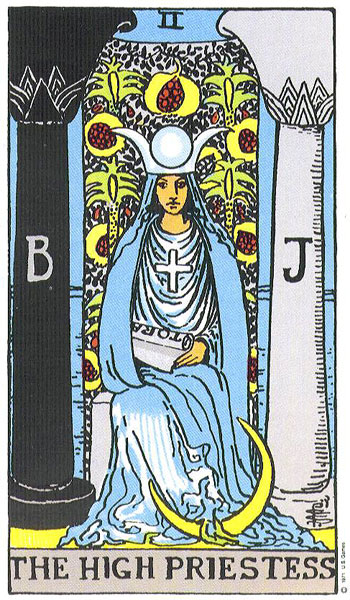 The High PriestessThe High Priestess protects what is not yet ready for language. Dreams, hunches, and timing matter more than f…
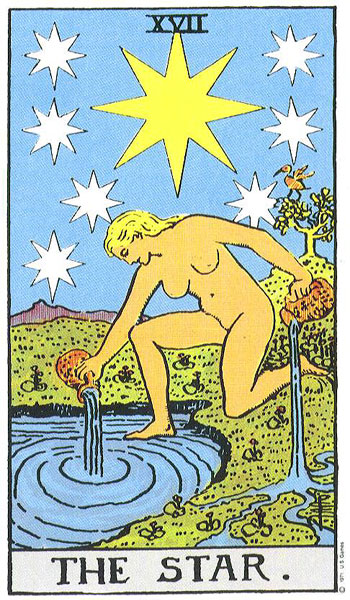 The StarThe Star follows wreckage with hope that is not naive: renewal, inspiration, a drink of clean water for the so…
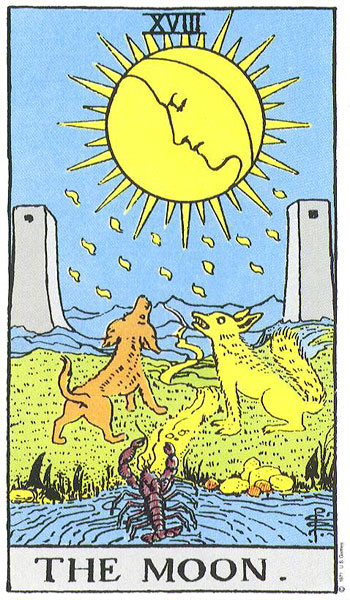 The MoonThe Moon walks the liminal: dreams, projections, what you sense but cannot yet prove. Anxiety and intuition sh…
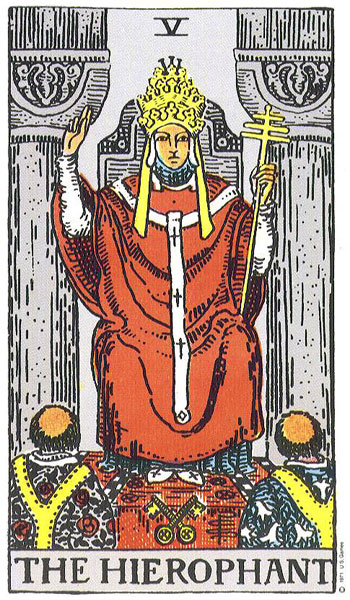 The HierophantThe Hierophant bridges the temple and the street: tradition, teaching, initiation, shared language. Upright, y…
Questions people ask
What does the Hermit tarot card mean?
It names a turn inward: solitude, study, and guidance that is earned rather than crowdsourced. The lantern lights a step, not a five-year plan. It is not a command to cut everyone off. It asks whether you can hear yourself, and whether the quiet you are choosing is a laboratory or a hiding place.
What can the Hermit mean in love?
A need for space, a slower pace, or a relationship that has to survive one person’s inner work. It can also appear when you are learning to be a companion without using the other person as noise. It does not predict lifelong aloneness. It asks what kind of distance would make the bond more honest.
How might the Hermit reversed be read?
As isolation that has become exile, cynicism, hiding, or the opposite: a refusal to ever be alone. Reversed can mean it is time to come down the mountain—or time to finally climb it. Look at whether your calendar, your phone, and your stories about “not needing anyone” are serving wisdom or fear.
Is the Hermit about finding a guru?
It can include a teacher, a therapist, or an elder, because Waite’s figure is also a guide. More often the first teacher is the quiet itself. Be wary of anyone who offers to replace your lantern with their sun. The star in the glass is small on purpose.
This page is a reference. Mystic Draw draws cards at random in a reading — it cannot promise this card will appear. How a three-card reading works · How to read tarot cards.