The Hierophant Tarot Card Meaning
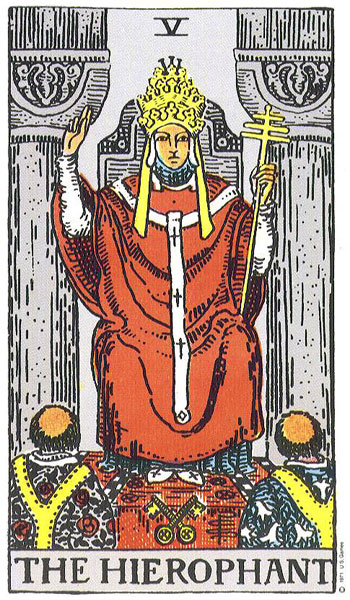
The Hierophant bridges the temple and the street: tradition, teaching, initiation, shared language. Upright, you learn from lineage—mentors, institutions, rituals that carry weight because others have tested them. Conformity can be medicine when it gives you a floor to stand on, especially if you have been trying to invent a whole culture alone.
- Arcana: Major
- Element: Earth
- Traditional keywords: tradition · teaching · spiritual guidance · conformity · shared belief
- Mystic Draw themes (upright): lineage · shared language · initiation · teaching · tested forms
- Mystic Draw themes (reversed): hollow doctrine · rebellion without a teacher · cynicism · bad-fit institution · unquestioned rules
Upright meaning
Upright, the Hierophant is the relief of not having to start from zero. Someone has already named the notes, the vows, the way a craft is passed. You may be the student or the one who has become, almost by accident, a transmitter. Either way, the card honors forms that have been worn smooth by many hands.
This is not a demand that you swallow a creed whole. It is a reminder that meaning is often communal. A blessing, a certificate, a weekly practice, a teacher who can be questioned: these are Hierophant technologies. They fail when they replace your conscience. They succeed when they give conscience a language.
Reversed meaning
Reversed, doctrine suffocates or hollows out. You may need to leave a room that only rewards obedience. You may also be throwing away every structure because one structure hurt you. Sometimes you need a new teacher, not “no teachers.”
Cynicism is a cheap robe. So is rebellion that still orients itself entirely around the old authority. The reversal asks what you actually believe, and whether you have a community that can hold that belief without demanding you disappear.
Love and relationships
In love, the Hierophant often points to shared values, ceremonies, and the moment a private bond meets a public world—families, communities, vows, the question of whether you are building a life that others can recognize.
It can also name a relationship that is trying to follow a script that does not fit the people in it. Meeting the parents, getting married, staying because “this is what one does”: none of these are automatically wrong. The card asks whether the ritual is expressing the bond or substituting for one.
Career and work
Work here is training, certification, apprenticeships, best practices. Borrow craft before you break rules—especially if you are new enough that “breaking rules” is mostly not knowing them yet.
Institutions can shelter a vocation. They can also flatten it. If you are the person translating a living practice into a handbook, notice whether the handbook still breathes. If you are allergic to all mentorship, notice whether that allergy is wisdom or an old wound wearing a clever hat.
Money and practical life
Money and the Hierophant meet at inherited rules: how your family talked about debt, what your culture treats as respectable work, the advice that “everyone knows.” Some of that advice is a floor. Some of it is a ceiling.
Tithing, dues, tuition, and professional guilds can all appear. None of them are automatically sacred or automatically a scam. The question is whether you are paying for belonging and skill, or paying to keep from being expelled from a story that no longer fits.
Personal growth
Spiritually, practice beats performance. Find a lineage you can question lovingly—or build a small, honest ritual if the large ones have failed you. The Hierophant’s keys are double: one gold, one silver in the usual esoteric reading, heaven and earth, inner and outer.
Growth is becoming someone who can receive teaching without kneeling on your own mind, and someone who can offer teaching without needing disciples. Initiation, in a reflective sense, is simply the moment you admit you are in a tradition, even if the tradition is “people who keep trying.”
Imagery and symbolism
Waite renamed the Pope the Hierophant—the one who shows the holy things—and Smith painted a gray-pillared interior with a triple crown and a three-barred cross. Two tonsured acolytes kneel; crossed keys lie at the figure’s feet, the Petrine emblem turned into a picture of transmission. The right hand is raised in a gesture that is both blessing and instruction.
The red robes of the students and the Hierophant’s white under-robe keep the scene ceremonial rather than merely bureaucratic. History of the image: Marseille’s Pope was already institutional; Waite wanted the office of interpreter, the person who stands between mystery and the street. When you read the card, look at whether the keys are being offered or withheld—and whether you are the one on the dais or the one on the stone floor.
What this card may be asking you to notice
Notice which traditions still give you a floor, and which ones only give you a costume. Who are you allowing to name reality for you? If you have no teacher and no peers, is that freedom, or a lonely refusal to be initiated into anything you cannot control?
Related cards
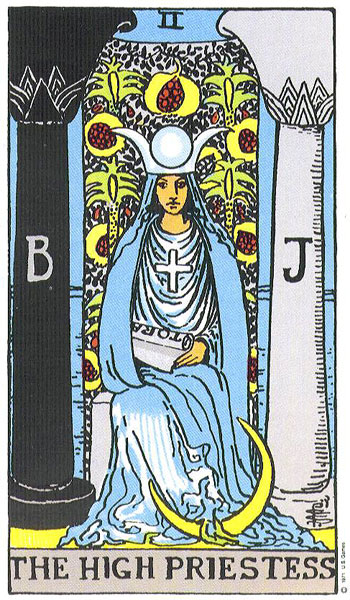 The High PriestessThe High Priestess protects what is not yet ready for language. Dreams, hunches, and timing matter more than f…
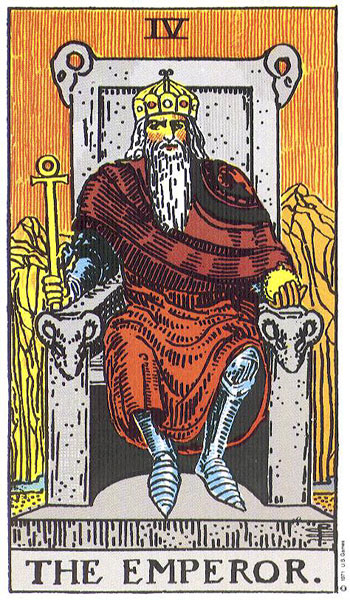 The EmperorThe Emperor structures chaos into something navigable: law, schedule, leadership, protection. Upright, authori…
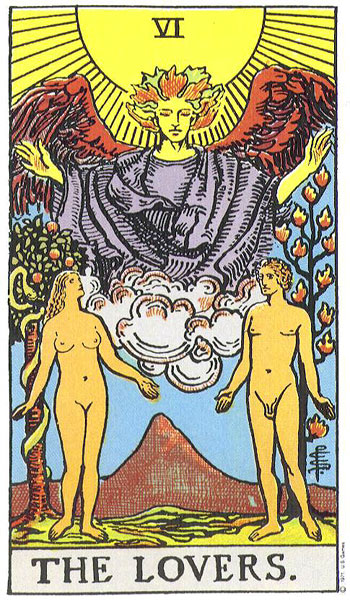 The LoversThe Lovers is choice with your whole self: alignment between head, heart, and ethics. Romance is common, but t…
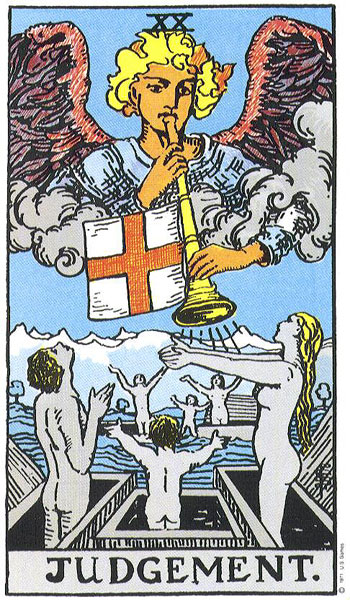 JudgementJudgement is the call upward: reckoning, rebirth, answering a vocation. Something in you—or in a larger story …
Questions people ask
What does the Hierophant tarot card mean?
It points to lineage, teaching, and shared forms: the ways a culture or craft hands meaning down. Upright, that can be a genuine floor—mentors, ritual, a tested method. It is not an order to obey every institution in your life. The rest of the reading shows whether the temple is still alive or only repeating itself.
What might the Hierophant mean in love?
Shared values, public recognition of a bond, ceremonies, or the pressure of “how this is done.” It can bless a relationship that wants a place in a community. It can also flag a couple living someone else’s script. Ask whether the tradition you are invoking actually describes the two of you.
How can the Hierophant reversed be understood?
As a bad-fit doctrine, a hollow institution, rebellion that still orbits the old authority, or cynicism that throws away all teaching. Reversed is not automatically “be a heretic.” Sometimes it is “find a better school.” Sometimes it is “you already know this, and the collar is only costume.”
Is the Hierophant a religious card?
It uses temple imagery because Waite and Smith were working in a Christian-occult vocabulary, but the function is broader: any mediating tradition—therapy schools, trades, academic fields, family rites. Read the religion literally if that is your life. Otherwise read it as the question of who gets to interpret the mystery for you.
This page is a reference. Mystic Draw draws cards at random in a reading — it cannot promise this card will appear. How a three-card reading works · How to read tarot cards.