
Six of Swords Tarot Card Meaning
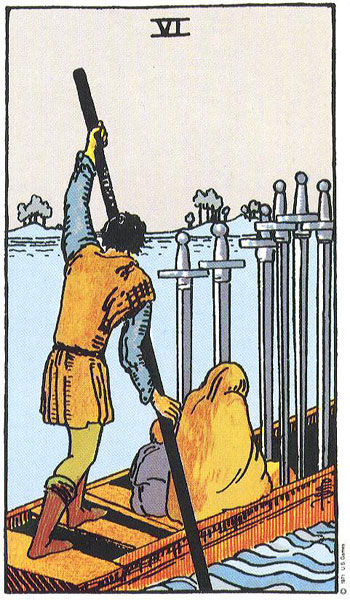
The Six of Swords is travel after trouble — not a parade, a ferry. You take what you must, including the thoughts that still sit in the boat, and you move toward a calmer shore. Distance here is a form of care.
- Arcana: Minor
- Suit: swords
- Element: Air
- Traditional keywords: transition · leaving difficulty · passage · mental shift · travel
- Mystic Draw themes (upright): passage · leaving the rough water · guided transition · thoughts packed for travel
- Mystic Draw themes (reversed): the boat turning back · unfinished shore · resistance to leaving · choppy delay
Upright meaning
Upright, this card is one of the gentler Swords: a crossing. Someone poles the boat; someone sits with a child or a bundled grief; six swords stand in the hull like unfinished conversations you are not required to swing right now. The water behind is choppy; ahead, it smooths. You do not have to be thrilled. You only have to be in motion toward slightly better conditions. Therapy, a move, a job change, a week away, a decision to stop arguing with a closed door — all can wear this image. The swords come with you. That is honest. Healing is not amnesia. It is changing the water you think in.
Reversed meaning
Reversed, the boat may be circling. Unfinished business on the near shore keeps calling you back. Or you have left physically and not yet mentally — the same argument, a new kitchen. Sometimes the reversal is a delayed departure: tickets, courage, money, a duty you cannot yet set down. None of this makes you a coward. Crossings require a ferryman, which is to say: help, timing, a craft that floats. If the water is still too rough to launch, the card asks what would make the hull trustworthy, not whether you should feel ashamed for still being here.
Love and relationships
In love, the Six of Swords can be two people leaving a storm together — couple’s counseling as a ferry, a household relocating, a truce that is also a journey. It can also be leaving a relationship that cannot become calmer water, which is a grief and a mercy at once. If you are the one in the boat, you do not owe a dramatic speech to the shore you are leaving. If you are the one watching someone go, their crossing is not a riddle for you to solve. Distance can be the kindest remaining language.
Career and work
At work, this is the transfer, the offboarding, the project you are handing to someone else so you can think in a quieter room. It can be leaving a toxic team without setting the building on fire. It can be a sabbatical that is actually a crossing, not a holiday. Bring the skills; leave the feud if you can. The six swords in the boat are the knowledge you keep. They do not all have to be weapons in the next harbor.
Money and practical life
As a money reflection, the Six of Swords often appears when a practical change is part of getting to calmer conditions: a budget that supports a move, a plan for a transition season, the cost of getting help. It does not promise that the far shore is wealthy. It suggests that remaining in choppy water also has a cost, including to your attention. Count both, with as little drama as you can manage. The ferry is a tool, not a lottery ticket.
Personal growth
For growth, this card is permission to let distance do some of the work. You do not have to metabolize every lesson in the house where the lesson hurt. Rituals of leaving — packing, a last walk, a letter, a new route home — help the mind understand that the geography has changed. Bring a companion if you can. The RWS boat is not a solo kayak. Passage is allowed to be assisted.
Imagery and symbolism
Smith’s Six of Swords shows a punter standing at the stern, poling a small boat toward the right of the card. In the boat, a seated adult in a cloak and a small child; six swords stand upright in the hull. The water on the left is rippled; on the right, it lies smoother. A far shore waits under a pale sky. Unlike the Knight of Swords, nobody is charging. The mood is subdued, almost liturgical. Waite wrote of a journey toward calmer conditions. The swords travel too — thought as cargo, not as a fight in progress.
What this card may be asking you to notice
Notice which shore you are still arguing with. Notice who is willing to pole the boat with you. The Six of Swords often asks you to let the crossing be incomplete and still be real.
Related cards
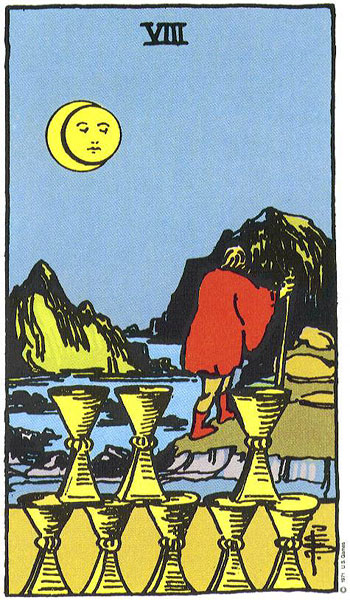 Eight of CupsA cloaked figure leaves eight stacked cups and climbs toward darker hills. The Eight of Cups is Water choosing…
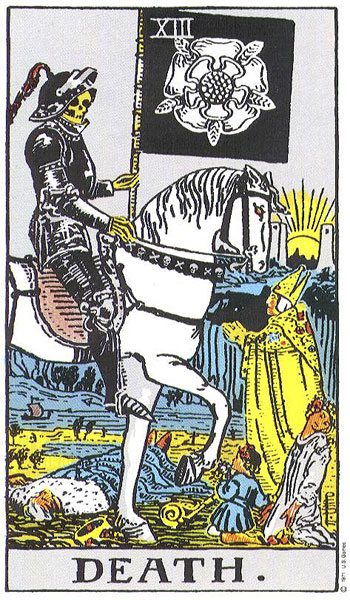 DeathDeath is transition, not only loss: an ending that clears space. Grief may be present, but so is relief when s…
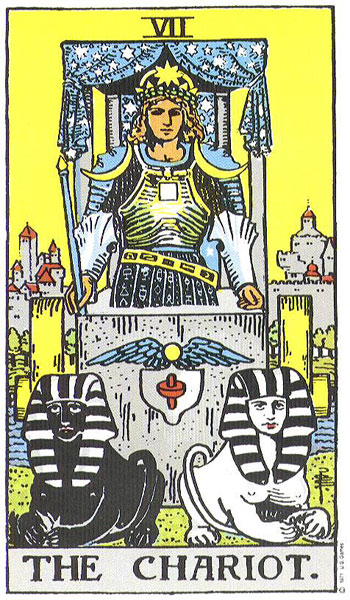 The ChariotThe Chariot wins through focus: opposing forces steered by will, not crushed. Momentum comes when you pick a l…
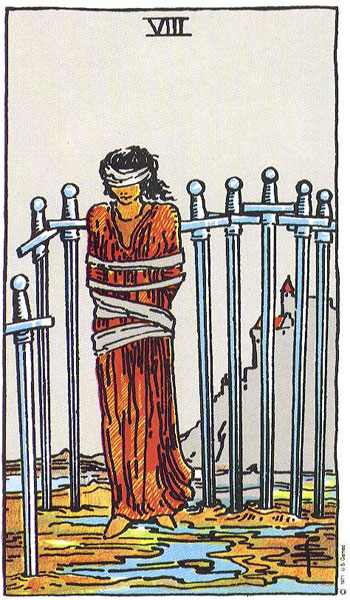 Eight of SwordsThe Eight of Swords is the feeling of being unable to move — bound, blindfolded, swords like a fence. Some cag…
Questions people ask
What does the Six of Swords tarot card mean?
It often means a transition out of difficulty toward somewhat calmer conditions — a move, a recovery, a guided leaving. Mystic Draw emphasizes that the swords (your thoughts, your history) come with you. The gift is new water, not a new past.
Is the Six of Swords about leaving a relationship?
It can be, and it can equally be two people leaving a storm together. The card describes passage, not a single plot. Read the surrounding cards and your actual life. Distance can be geographic, emotional, or simply a change in how you argue.
What might reversed Six of Swords ask?
It may ask what keeps turning the boat around: unfinished business, fear, logistics, or loyalty that has become an anchor. It does not shame delay. It asks what would make the crossing safer and more true.
This page is a reference. Mystic Draw draws cards at random in a reading — it cannot promise this card will appear. How a three-card reading works · How to read tarot cards.